“Record Shop Ramblings” is an interview series with record shop owners.
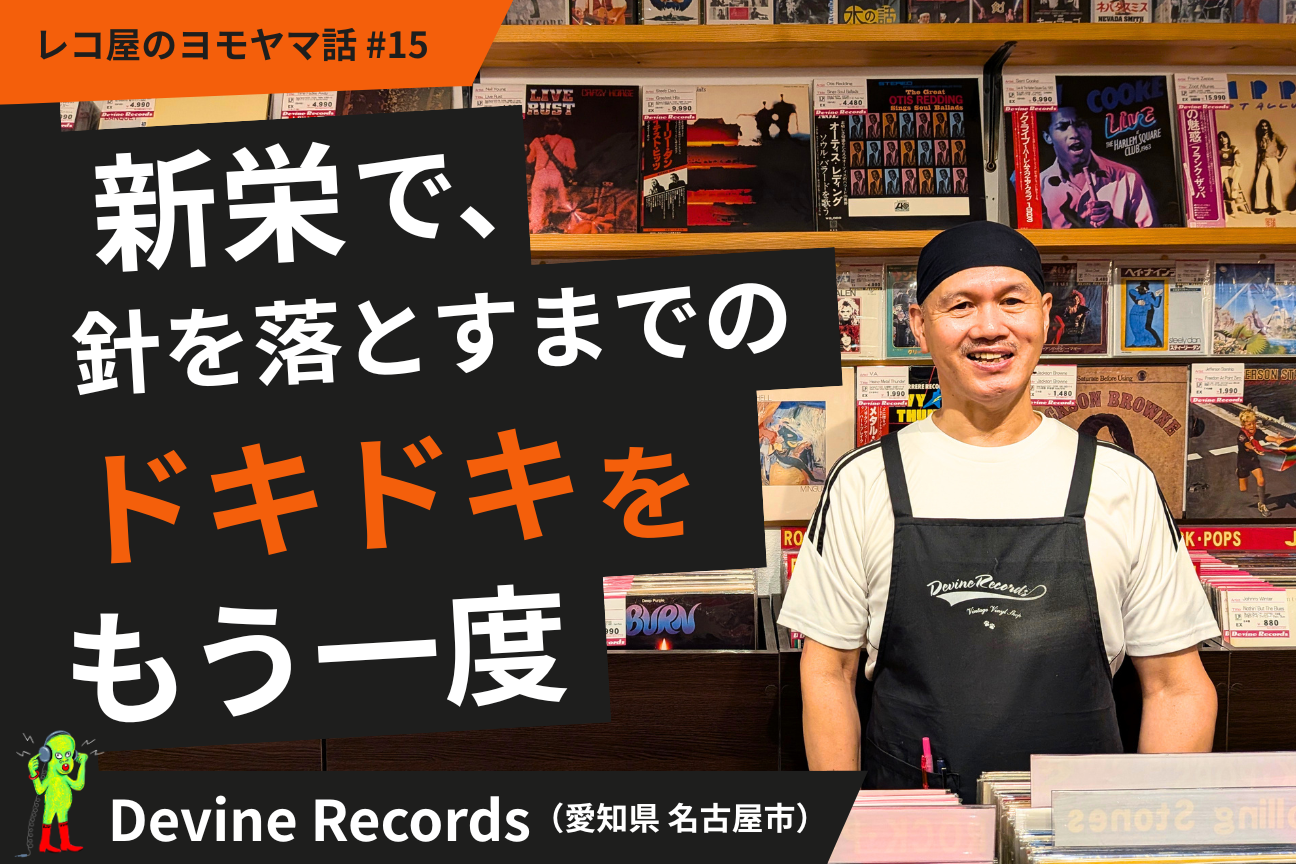
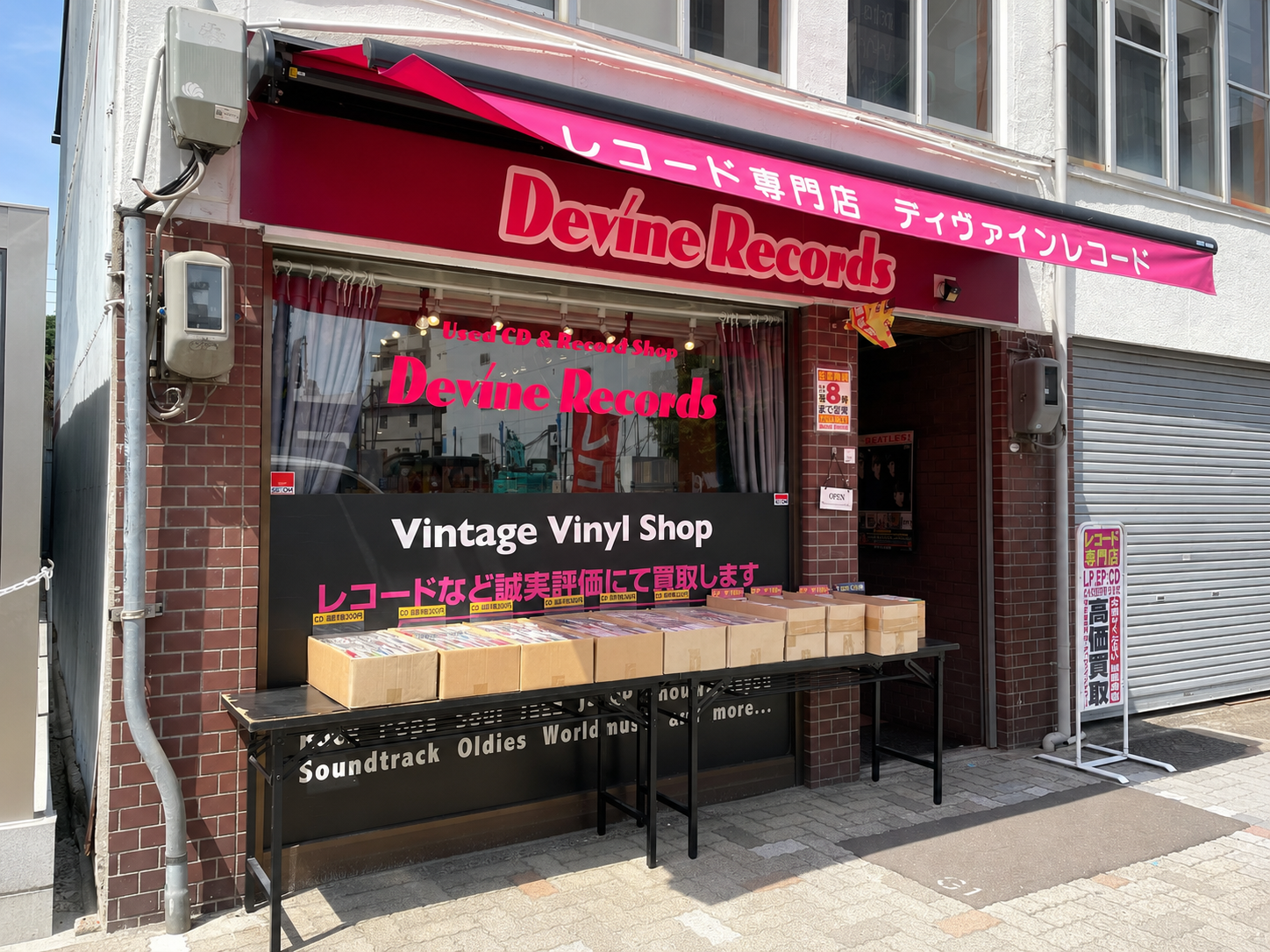
Take the Higashiyama Subway Line from Nagoya Station, and you will find “Devine Records” just a short walk from Shinsakae-machi Station. It is a street-level record shop facing Hirokoji-dori, one of Nagoya’s major avenues.
“For me, records have this thrill that builds up before you drop the needle on music you have never heard before.”
That is what owner Kanematsu-san tells us. From the 7-inch records he listened to at home as a child, to the discos and jazz cafés he visited as a student, and later his experience running a secondhand bookstore, records have always remained close to his life. We spoke with Kanematsu-san about his first encounters with music, how he thinks about the shop today, and what he hopes to share through records.

What first drew you strongly to music and records?
Kanematsu-sanWhen I was a child, we had a small record player at home. My mother and her younger sister also had a lot of 7-inch singles, the kind we call “donut-ban” in Japan.
There were Japanese pop records and Japanese-language covers of foreign songs. I listened to them one after another when I was a kid.
For me, the greatest appeal of records is the excitement you feel before placing a record you have never heard on the turntable and dropping the needle. The little crackles and surface noise, the pops and soft hiss — all of that is part of what records are. If a record sounds too clean, it almost feels strange to me.
I think records are a medium that lets you encounter songs, artists, and genres you do not yet know. That feeling I had toward records as a child has never really changed, even now.
How did you experience music during your student days?
Around junior high school, friends in my neighborhood started introducing me to rock music. I was an only child, so I did not have older siblings to influence me, but some of my classmates had older brothers or sisters. They would record Led Zeppelin and Deep Purple records onto cassette tapes for me. The sheer power of that hard rock sound really struck me.
In high school, I played in a band with my classmates for the school festival. Back then, tablature was not easy to find, so I listened to records over and over, learning guitar solos and riffs by ear.
There was also a record shop near my house, and I went there almost every day even when I did not buy anything. The posters on the walls and the music playing in the shop always caught my attention. At the time, for me, the main ways to discover new music were the radio, record shops, and discos.
On Saturdays, school ended around noon. I would go home and listen to a radio program that played overseas pop rankings. That is how I discovered West Coast music and female vocalists.
Discos back then also had daytime hours when junior high and high school students could enter. They did not serve alcohol, but there were drinks and food, so for us, it was like a hangout where we could listen to music.
Near one of those discos was a secondhand record shop that carried imported records. The moment I walked in, the whole atmosphere felt like America. The music playing, the smell of records — everything felt new to me. I would buy a record for around 500 yen and take it home. That was really exciting.
You were also involved in theater during university.
At university, I joined the theater club. I was interested in acting on stage, and I also wrote scripts. Through theater, I started reading more books, and thanks to a senior student who knew a lot about classical music, I began listening to classical music and jazz as well.
On days when my university classes ended in the morning, I would go into central Nagoya and visit a jazz café that was open during the day. I would sit there with a single cup of coffee and listen to jazz for two or three hours. Looking back, it was such a free and open time.
In that way, I listened to all kinds of music: rock, disco, soul, Eurobeat, classical, and jazz. But no matter what else I was doing, records never really left my life.
What path did you take after entering the working world?
After working at a company for about four years, I went independent at the age of 29 and opened a secondhand bookstore. It was not only books; I also carried records and CDs, so it was more like a mixed shop. I ran that for about 15 years. After that, I did other work as well, but somewhere inside me, I always had the desire to run a record shop again.
I had a personal attachment to Shinsakae. It was an area I often visited during my university days, and I always thought that if I ever opened a record shop, this would be a good place for it.
Then I heard that the current space had become available. It was on a major avenue, at street level, and on the first floor. In central Nagoya, you do not often come across a location like that. I was not ready to open right away, but I did not want to let the place go, so I made up my mind.
Are there any characteristics unique to being a street-level shop on Hirokoji-dori, one of Nagoya’s major avenues?
I do not want the shop to feel intimidating. Maybe because it is a street-level shop, many people come in even if they did not originally intend to buy records. Young couples might stop by after visiting a nearby café or restaurant and say, “Wow, there are so many records here.”
If people like that can get a sense of what a record shop is like, that makes me happy. I think this can be a place where people first experience the atmosphere, not just a place where they come only to buy something.
I also try not to approach customers too much from my side. If someone is immediately greeted with “Welcome” or “What are you looking for?” it can feel like pressure. Some people are just looking around, almost like window shopping. That may be the kind of customer service that suits a street-level shop.
Not everyone who comes into a record shop is there to buy a record. Some people just notice that there is a record shop and wonder what it is like. They want to take a quick look. So first of all, I want people to feel free to browse. If they find something they want, of course I would be happy if they buy it. But it is also fine if they simply enjoy the atmosphere, look through the shelves for a while, and leave.
Of course, if a customer asks me, “I am looking for this kind of genre,” or “What kind of music is this?” I will help them. But if I step forward too much from the beginning, I feel like I might interrupt the free time they are having in the shop.
Is there anything you pay attention to in how the shop is presented?
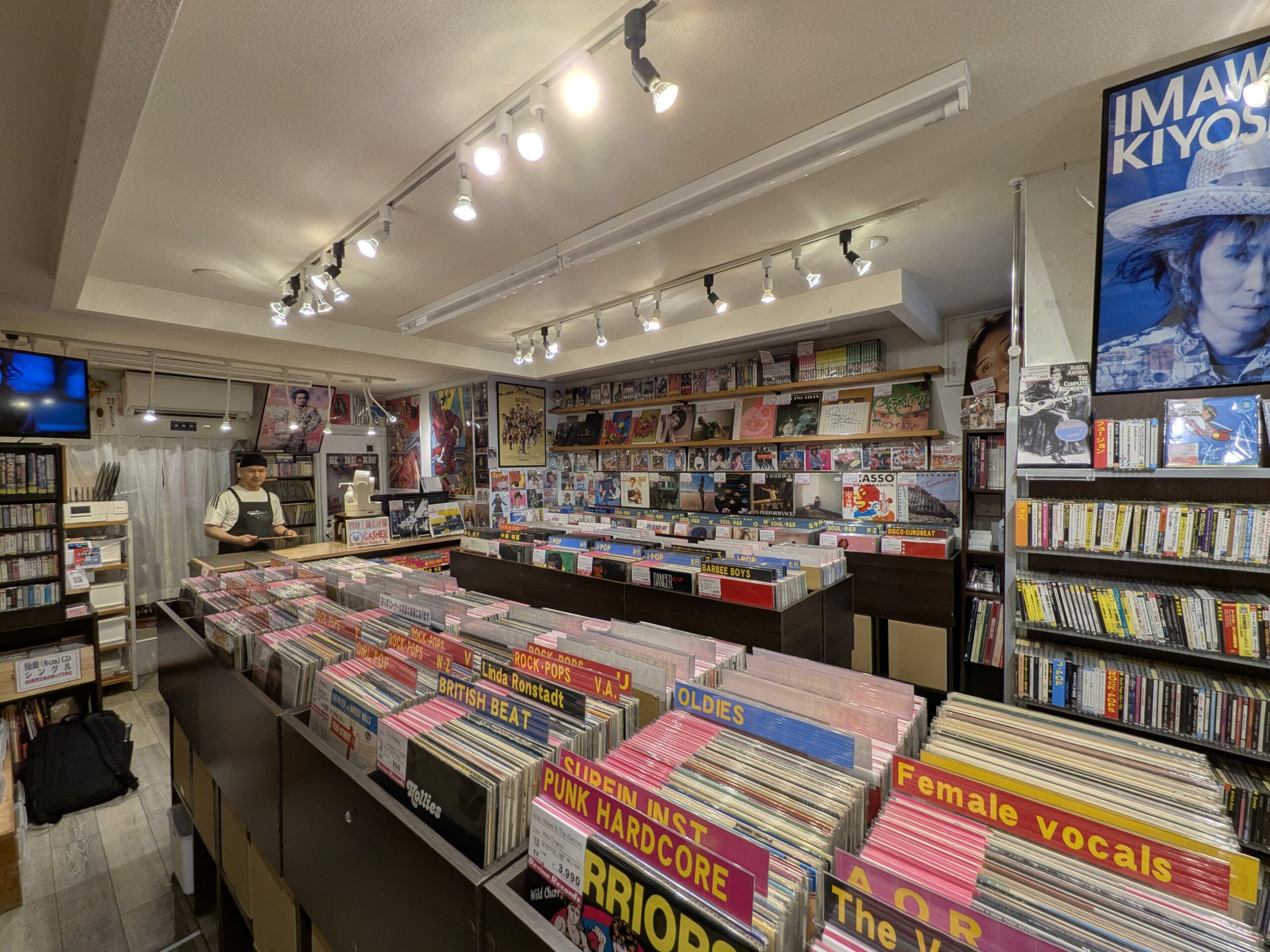
The price cards are not handwritten; I print them from a computer. We also have older customers, so I try to make the text and prices as large and easy to read as possible.
I want the shop to be easy to understand not only for people who are used to record shops, but also for people entering one for the first time. It may be a small thing, but I think that kind of readability also makes the shop easier to enter.
I often play oldies in the shop. That is music that still excites me. I listened to it a lot when I was a child. The melodies are beautiful, light, and enjoyable for anyone. The songs are also just the right length, around two and a half minutes. I think oldies often have a quality that makes people feel happy, rather than digging deeply into the darker sides of human emotion. When I play them in the shop, younger customers sometimes say, “This song is cute.” Some even look at a record jacket and say, “This face is cute.”
I enjoy seeing those reactions. It is not always about having detailed knowledge. First, you simply feel something. I think entering music from that point is completely natural.
What kind of place do you want Devine Records to become?
Today, you can listen to music instantly on your smartphone, and you can quickly find out what is popular. Of course, there is genuinely great music within the mainstream of each era.
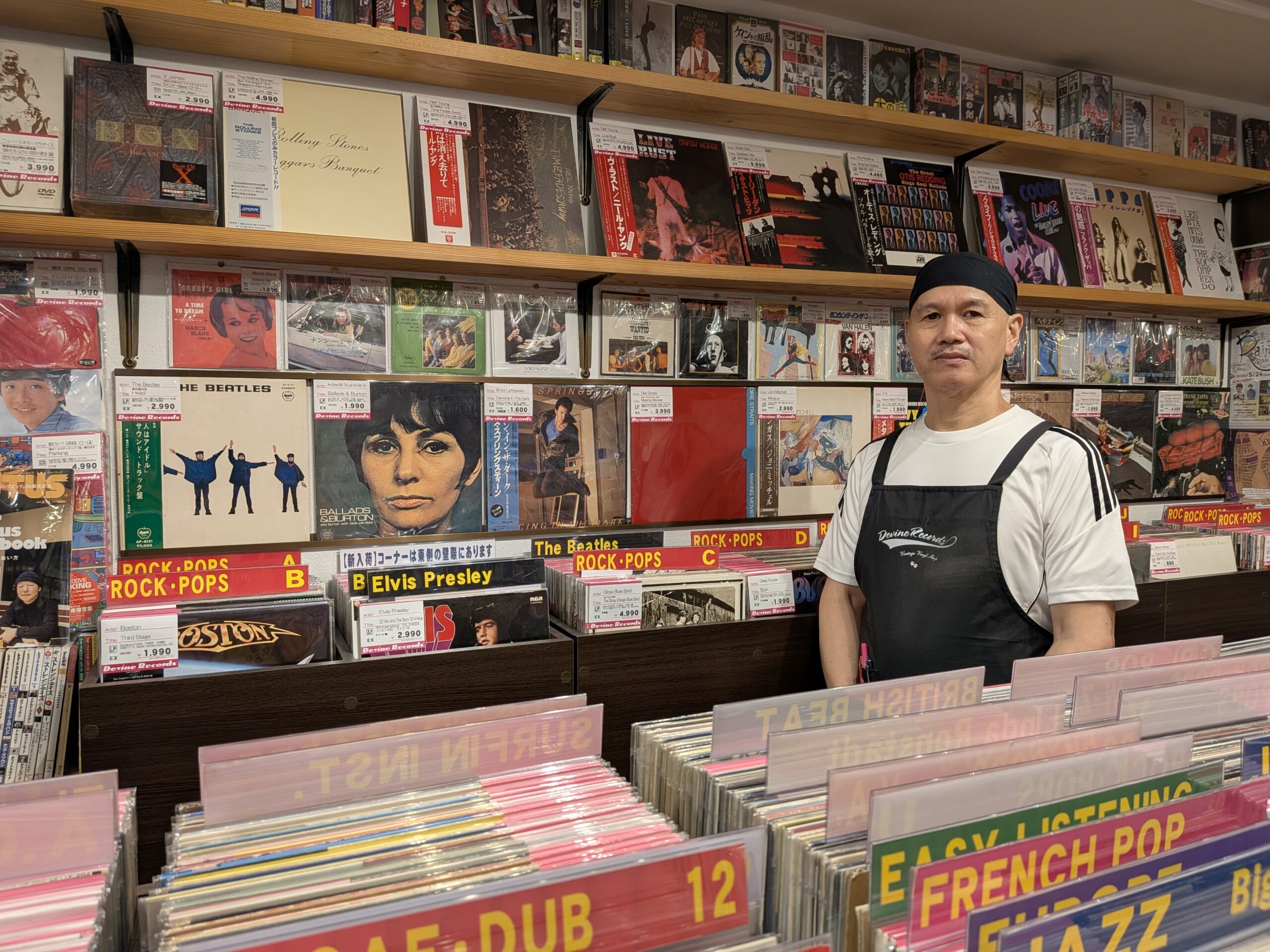
But rather than listening to something just because everyone else is listening to it, I hope people can have the feeling of, “This is what I listen to.” I want them to take their time and think about what they truly like.
I think records are suited to that kind of listening. You look at the jacket, take the record out, drop the needle, and wait for the sound to begin. That time is part of the music too.
Even if something does not click with you at first, you may start to understand its appeal after listening to it many times. Finding an artist you love does not have to happen quickly. I think it can take years.
Even if a record is old, it is new music if it is new to you. If you discover something nobody else is listening to, something nobody else has found yet, then in that moment you can feel like you are the first person in the world to have discovered that music.
At Devine Records, I would be happy if people could encounter that kind of “old but new” music.
Recoya VIEW
The phrase “the thrill before dropping the needle” seemed to capture Kanematsu-san’s way of thinking about the shop. Records are not treated as something only for people who already know them well. Instead, the shop is open to those who have yet to discover them. That attitude is also connected to the easygoing accessibility of a street-level shop.
Rather than actively calling out to customers, Kanematsu-san lets them browse freely first. It is not only about buying something; it is also about feeling the atmosphere of a record shop. That sense of distance feels kind to people entering a record shop for the first time.
Instead of simply following whatever music is popular, there is joy in finding music that makes you feel, “This is what I listen to.” Devine Records may be the kind of place where you can slowly discover music that feels like your own.